Is AI the Future of Forex Trading?
A Trader’s Journey Through Data, Emotion, and Innovation
Sumit Mehrotra
5/5/20264 min read
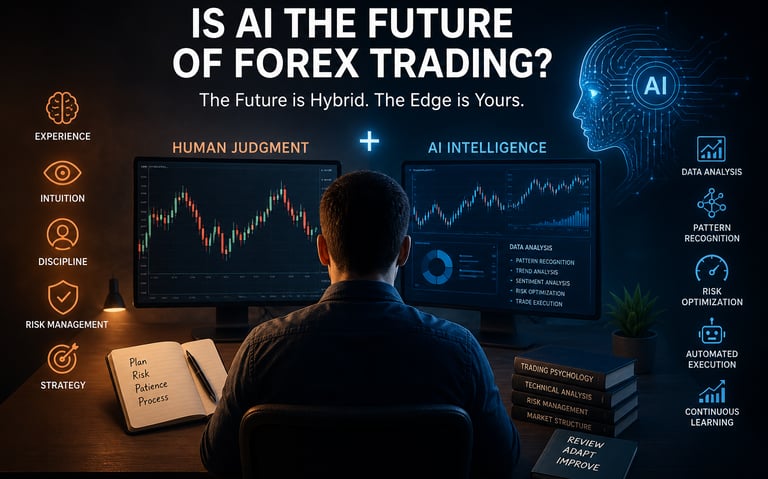
When I first stepped into the world of forex trading, my tools were simple: a notebook, a couple of screens, and a belief that discipline came from willpower alone. I tracked levels by hand, watched candlesticks form in real time, and convinced myself that raw screen time would eventually turn into mastery.
What I didn’t expect was that the biggest transformation in my trading journey—and in the trading world as a whole—would come not from chart patterns or indicators, but from the rise of artificial intelligence.
Over the years, as I grew as a trader, coached hundreds of others, and built a community through Tradewisenet, AI slowly shifted from something only hedge funds discussed to something retail traders now debate daily. And like many others, I once wondered whether it was just another buzzword.
Today, after experiencing both the advantages and the limitations, the question I find myself asking isn’t whether AI is shaping forex trading. It’s how far its influence will reach—and what role we, as traders, will play as that evolution continues.
When AI Reinforced What Experience Already Taught Me
My early trading life was dominated by instinct, replaying charts, and relying on what I believed were reliable patterns. Eventually, I began noticing how often my analysis conflicted with some of the data through an AI tool. Not to confuse AI with Expert Advisor (EA) robots, the latter are algorithms that function as a computer program, whereas the AI tools work via machine learning and keep improving as they analyse more data and scenarios.
Even before AI entered the picture, I understood the importance of discipline. Emotional trading destroys accounts faster than any technical mistake, and I’ve seen it countless times with traders I’ve mentored.
But watching AI-driven tools execute decisions without hesitation or second-guessing was a lesson in itself. They didn’t fear a stop-loss. They didn’t chase after a missed entry. They didn’t double their lot size to “recover a bad day.”
They followed a plan with the kind of consistency most traders aspire to.
It made me reflect deeply on why many traders struggle—not because they lack a strategy, but because they lack consistency. AI’s unemotional execution highlights this truth in a way that’s sometimes uncomfortable but always valuable.
Patterns, Data, and the Reality of Market Behaviour
One of the most eye-opening experiences in my career came from observing AI systems interpret price behaviour that I had studied for years. There were moments when markets behaved in ways that didn’t align with my expectations at all—such as fakeouts before news events or subtle shifts in volatility during low-liquidity periods.
These tools would identify recurring characteristics that weren’t obvious in real time. For example:
The way EUR/USD often reacts in the moments before a high-impact news release
The hidden correlation between USD pairs during certain risk-on or risk-off phases
The quieter micro-patterns that form during transition periods between major sessions
This wasn’t AI predicting the future like a crystal ball—it was AI showing me what the market had been quietly doing all along. Patterns I had sensed intuitively became far clearer when supported by comprehensive data.
When AI Challenged My Analysis
There was a particular week when EUR/USD was coiling tightly, and every fibre of my experience told me it was primed to break higher. Many traders in a programme I was running at the time thought the same.
Yet the data-driven analysis tools I was using flagged declining volume strength and an intra-session imbalance that suggested the exact opposite.
But then, I have strict risk management principles, and I use hedging for trades that don't go in my favour. And that's really helpful as the market never behaves according to what we think it should do.
AI didn’t replace my judgment, but it forced me to challenge my assumptions. And in trading, that ability is priceless.
But It Hasn’t All Been Smooth Sailing
The excitement around AI can sometimes overshadow its limitations. Over the years, I’ve also seen where it falls short and why traders must treat it as a tool, not a replacement.
AI Struggles in Extreme Market Events
I’ve lived through sudden geopolitical announcements, unexpected central bank shifts, and market behaviour that defied every logical pattern.
AI systems relying on historical patterns simply cannot anticipate a true black swan moment. Human experience, instinct, and contextual awareness are still irreplaceable in those moments.
AI Can Create Overconfidence
I’ve met traders who placed full trust in AI signals without understanding market context. They believed automation meant safety. But AI doesn’t understand geopolitical tension. It doesn’t watch central bank interviews. It doesn’t read the pulse of a nervous market.
Trading blindly, even with AI, is still trading blindly.
AI Can Make Traders Passive
The most dangerous aspect of easy automation is that traders begin to disengage. They stop learning. They stop reviewing. They stop refining.
A trader who hands over all responsibility to a machine eventually loses the skills required to survive as conditions change.
The Hybrid Future: Where We’re Really Heading
The longer I trade and the more traders I support, the clearer the future becomes. AI is not here to replace traders. It’s here to elevate them.
In reality, the most effective approach is hybrid:
AI as an Analyst
AI excels at analysing large datasets quickly. It highlights tendencies, patterns, and behaviours that deserve attention. But humans interpret what those patterns mean in the broader market environment.
AI as an Executor
Systems can execute trades with precision and consistency. Humans decide when the environment is stable enough to trust those executions.
AI as a Risk Manager
Machines enforce rules perfectly. Humans determine the rules themselves.
AI as a Teacher
By surfacing hidden patterns, AI indirectly teaches traders more about their own strategies.
The point is clear: AI amplifies human intelligence; it doesn’t replace it.
So, Is AI Really the Future of Forex Trading?
From what I’ve lived, observed, and experienced, I believe AI will play an increasingly central role in forex trading. Markets are becoming more complex. Data is becoming more abundant. The traders who thrive will be those who know how to navigate both.
But the future is not AI alone.
The future is the trader who knows how to combine intuition with data, discipline with automation, and experience with innovation.
AI helps us see what we once overlooked.
It sharpens our edge.
It challenges our biases.
It improves our consistency.
But we remain the strategist, the risk manager, and the ultimate decision-maker.
AI isn’t the end of human trading, it’s the evolution of it.
© 2025. All rights reserved






Company Registration Number 16824545
Risk Disclosure: All trading involves risk. Spread bets and CFDs are complex instruments and carry a high risk of rapid loss of capital due to leverage. You should consider whether you understand how spread bets and CFDs work and whether you can afford to take the high risk of losing your money. Please refer to our Disclaimer Statement for further information.